
Babylonian Civilization: Law, Learning, and Power in Ancient Mesopotamia
The Babylonian civilization shaped ancient Mesopotamia through law, science, architecture, and culture, influencing later civilizations for centuries.
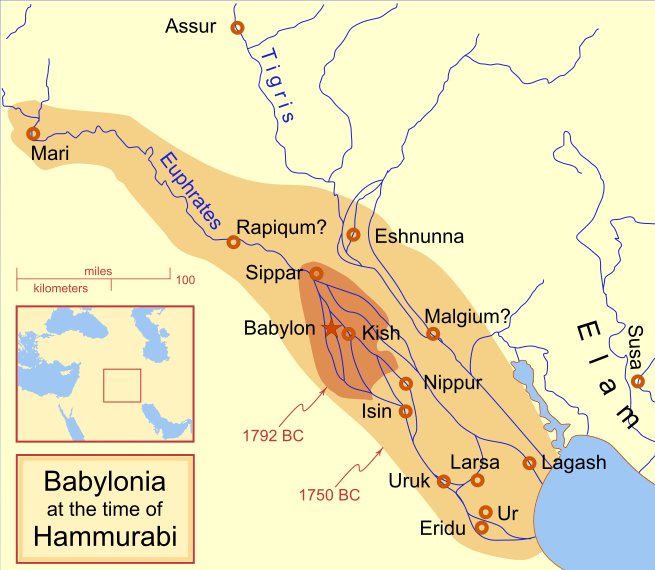
Geographic Setting and Rise of Babylon
The Babylonian civilization developed in central Mesopotamia along the Euphrates River, in present-day Iraq. Babylon itself began as a small settlement but gradually rose to prominence due to its strategic location along trade routes and fertile agricultural land.
By around 1900 BCE, Babylon emerged as a powerful city-state, eventually becoming the political and cultural heart of Mesopotamia under strong rulers.
Political Power and Administration
Babylon was governed by kings who ruled with centralized authority. Unlike earlier Sumerian city-states, Babylon developed a more unified system of administration that extended control over large territories.
The most famous Babylonian ruler was King Hammurabi, who expanded Babylon’s influence through military campaigns and diplomacy, creating one of the earliest empires in the region.
Law and the Code of Hammurabi
One of Babylon’s greatest contributions to civilization was the creation of a written legal system. The Code of Hammurabi is among the oldest known sets of laws, carved onto a stone stele for public display.
These laws governed trade, property, family relationships, labor, and punishment. Justice was based on social status, reflecting the structured hierarchy of Babylonian society, but the idea that laws should be written and known was revolutionary.
Social Structure and Everyday Life
Babylonian society was divided into classes, including nobles, free citizens, laborers, and slaves. Merchants, artisans, farmers, and scribes played essential roles in the economy.
Daily life centered on agriculture, trade, and family. Houses were built from mud brick, diets relied on grains, fruits, and meat, and markets served as important social and economic spaces.
Religion and Spiritual Beliefs
Religion was deeply woven into Babylonian life. The Babylonians worshipped many gods, believing divine forces controlled natural events and human fate.
The chief god of Babylon was Marduk, who symbolized order and authority. Temples and ziggurats dominated the city, serving as religious, cultural, and economic centers.
Learning, Writing, and Literature
The Babylonians inherited and expanded upon Sumerian cuneiform writing. Scribes recorded laws, business contracts, religious texts, and scientific observations on clay tablets.
Babylonian literature included myths, prayers, and scholarly texts. Many versions of the Epic of Gilgamesh come from Babylonian copies, preserving stories that shaped ancient thought.
Science, Mathematics, and Astronomy
Babylon became a major center of learning. Babylonian scholars made advanced contributions to mathematics, using a base-60 number system that still influences timekeeping and geometry.
Astronomy was particularly advanced, with detailed observations of planets, eclipses, and star movements. These studies were used for calendars, agriculture, and religious interpretation.
Art, Architecture, and Urban Life
Babylonian architecture reflected both power and religious devotion. The city was famous for its massive walls, grand temples, and ceremonial gates.
Artistic achievements included relief carvings, glazed brickwork, and decorative motifs. Structures such as the Ishtar Gate symbolized Babylon’s wealth and craftsmanship.
Decline and Enduring Influence
Over time, Babylon faced invasions and political decline, eventually falling to foreign powers including the Persians. Despite this, Babylonian culture did not disappear.
Its legal principles, scientific knowledge, and administrative ideas influenced later civilizations across the Middle East and beyond, securing Babylon’s place as one of the most important cultures of the ancient world.